Monday, October 26, 2009
The questions that invisible India ask
In a very short span of time, starting last November with the attacks in Lalgarh, Naxalite menace has become a hotly discussed issue from the high echelons to the power to informal chats in every nook and corner of our nation. Everyone seems to take it for granted that the Naxalites are a menace to the nation. But the question we should be asking ourselves is why are these people and why have they became a issue of national importance now, whereas a short time back they were local issues that we dismissed with a fleeting glance.
These people are a part of what Madhukar Shukla calls the invisible India. Invisible lives in the faraway villages, forest areas and the urban slums. They are the people who have almost no control over their own destiny. Only thing that they do is hope and believe. Hope for better monsoons, hope for enough work to earn something for their basic needs, hope for safe health, hope for at least a meal a day. Another they are supposed to be doing is believe. Believe what the babus who come every four years or so believe what they promise and vote.
Why do A a section of people have to live as 'invisibles' in a modern society? Firstly the media and we the 'visible' society doesn't care for such people and the challenges they face.We are content to live in the a bubble where media acts as an anesthetic to such issues. What most of our mainstream media caters –the news, the advertisements the debates everything –is aimed at the visible India. We who are are a part of visible India are the ones who live in the 'Matrix' like world created for us by the media. We care and hotly debate ceaselessly about India's nuclear strength compared to Pakistan, GDP rise compared to China, Indo –US deal , stock market , cricket triumphs, celebrity marriages etc . They buy the products endorsed by their favourite stars on TV and hangout at malls and cinemas every weekend. The media interested only in keeping this section of society who are potential consumers for the products they advertise -satisfied .The media and the visible India are indifferent about the Invisible counterparts. They are not interested in the basic issues which they take granted for themselves. In reality the lack of education, nutrition or healthcare, and other services is more chronic than in the picture painted before us by the media. Only when something terrible and unexpected happen does visible India care to turn back and look at the invisible India. From this stems the second reason for the invisible India to exist
This has got to do with the people whom we,directly or indirectly, elect to power, to ensure the welfare of each and every citizen of our nation. India , fortunately, has brilliant strategists, bureaucrats and statesmen at the helm of various departments and committees that steer our nation's general policies. But somehow their visions have not been executed well and the benefits of crores of money spent on empowering various sections of the society have not been utilised well. There are corrupt and criminal politicians, corrupt officials and in some cases corporates who are ready to woo these people in power for their own benefits. The funds and schemes aimed at the welfare of the invisibles get diluted by the greed of these individuals and forces which are free to continue to do so since neither the media nor the civil society actually notice such malpractices.
These two factors, the apathy of the media and the rest of society and the corruption in the corridors of power, are the root causes of the problems that keep the huge section India invisible even after six decades of the promises that came with our independence. They lack basic infrastructure like roads and electricity and services like hospitals or schools and find it impossible to even dream of living conditions that we enjoy. Few years back an official committee looking into these put it like this "We have two worlds of education, two worlds of health, two worlds of transport and two worlds of housing'' .Add to this fact the rogue ideologists -with or without external help -who still dream of taking over the power through armed struggle and the incompetency of local security forces in nipping such tendencies from the bud. And it easy to see why we hear terms likes 'prisoner of war' and 'war against the state' in such a situation. It is out of desperation that the youth who support Naxalites do so (although the cases of forced recruitment have also been reported).For them they can divert the attention to their long unattended needs only by breaking our comfort zones that . And this seems to be working for them at least on a short term basis. (But whether such a form of protest is justified in a democratic society –even in situations of dire helplessness – is an entirely different question)
What is the way out of this situation?
On one side there has to be an immediate solution of reaching with peace with the extremists so that no more damage happen to the civilian life and the public property. Government has taken a commendable stance by acknowledging that those who have taken to armed struggle too are also our part of our nation and that no democratic nation uses military against its own citizens. By calling for unconditional talks it seems they are taking the responsibility to fulfill the legitimate demands of naxalites more seriously. On the other hand the naxalites have to understand the fact that their dream of taking over power through armed struggle will remain just a dream and that in democracy it is through dialogue and not through violence that solutions are reached and accept the offer of the government.Secondly the Government have to start taking steps -with the cooperation of states and local authorities and relevant NGOs- for the continued development of the areas which act as breeding grounds for extremism. Back in 2008 government had announced a huge fund for the development of tribal areas to be implemented with the cooperation of other players. More such steps with more focus on infrastructure development and improvement of human conditions must come up in a timely manner .Basic infrastructure needs to be developed along with equipping the security forces in such a way that unwanted elements are unable to spread their vendetta against state .
But what remains to be seen whether such plans for development,as happened several times in the past, remains on paper due to the corruption and vested interests of various forces. Naxalite challenge should act as a wakeup call for the entire nation to ensure that the benefits of various efforts reach the target group's .And the media and the civil society have to play the role of watchdogs by paying more attention to the way these plans are executed.Only then can we prevent such challenges from repeating themselves.
Tuesday, October 20, 2009
The story of two books
Two books I read about five months back have had a very deep impact on me, they have almost entirely changed my way of thinking and my world view.
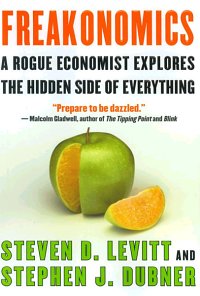
First book is 'Freakonomics' written by Steven D. Levitt, a professor in Economics. What he does basically is 'exploring the hidden side of everything'. He answers some apparently trivial questions - like 'What does Sumo wrestlers and School Teachers have in common?' Or 'Why does drug dealers still live with their moms' etc - on the basis of various economic and social data available to him through his research. What is special about the book is that it forces you to question things you have taken for granted and to see them in an entirely different light. How did this book affect me? I believe it has made me more open minded to ideas. It has forced me to ask 'What if I am wrong?'. I have started thinking of the cause-and-effect cycle in an entirely different way. It has taught me to ask questions about even the basic things in our life that we take for granted. For example would the Cola we drink taste as good as it does now, if it were packaged in a different way? Everything we take for granted in our life has a story behind them. And the story what we think are true aren't always true.
Second book is 'The God Delusion' by British evolutionary biologist Richard Dawkins (who is regarded as number one enemy of creationists around the world).As the title suggests it is a book on atheism ,he debunks the various myths associated with religion (mainly Christianity and Judaism) and offers an alternate explanation to things we think are rooted in religion. Like morality, does morality comes from religion? Or is that humans, through the process of evolution, have reached upon a certain set of things which are considered good and bad? So what did this book teach me (apart from strengthening my atheism?).Basically it reminded me again that we homo sapiens are just another species on earth. Simple enough. But the thing is most of us don't act as if we are conscious of this fact. In our thinking we have divided the living things into three- plants, animals and human beings. But this book has forcefully reminded me that the divide between animals and humans doesn't exist. We too are a product of evolution through millions of years .But in a blink of time (in about 35,000 years) we have come to control the earth and nature unlike any other species before. And this not because of any divine providence, but because of different physical advantages and skills we achieved through the process of evolution.
Everything around us even the mobile phones or laptops we use, the language we speak or write, the type of food we eat are all products of change of some kind or the other. Even the way we behave and every custom we follow in our society too has undergone this change. They were not like this from the day one of human life (and there was not even a day one). Anything you can see around yourself has a reason for its existence which is rooted in its past. Its only when we understand the past that we will be able to make sense out of our present.
It is not that I have not thought about some of these things before reading these books. But these books have made me think even more deeply about such things. I would recommend these books to anyone who are -as a blurb in Freakonomics says- 'prepared to be dazzled'.
First book is 'Freakonomics' written by Steven D. Levitt, a professor in Economics. What he does basically is 'exploring the hidden side of everything'. He answers some apparently trivial questions - like 'What does Sumo wrestlers and School Teachers have in common?' Or 'Why does drug dealers still live with their moms' etc - on the basis of various economic and social data available to him through his research. What is special about the book is that it forces you to question things you have taken for granted and to see them in an entirely different light. How did this book affect me? I believe it has made me more open minded to ideas. It has forced me to ask 'What if I am wrong?'. I have started thinking of the cause-and-effect cycle in an entirely different way. It has taught me to ask questions about even the basic things in our life that we take for granted. For example would the Cola we drink taste as good as it does now, if it were packaged in a different way? Everything we take for granted in our life has a story behind them. And the story what we think are true aren't always true.
Second book is 'The God Delusion' by British evolutionary biologist Richard Dawkins (who is regarded as number one enemy of creationists around the world).As the title suggests it is a book on atheism ,he debunks the various myths associated with religion (mainly Christianity and Judaism) and offers an alternate explanation to things we think are rooted in religion. Like morality, does morality comes from religion? Or is that humans, through the process of evolution, have reached upon a certain set of things which are considered good and bad? So what did this book teach me (apart from strengthening my atheism?).Basically it reminded me again that we homo sapiens are just another species on earth. Simple enough. But the thing is most of us don't act as if we are conscious of this fact. In our thinking we have divided the living things into three- plants, animals and human beings. But this book has forcefully reminded me that the divide between animals and humans doesn't exist. We too are a product of evolution through millions of years .But in a blink of time (in about 35,000 years) we have come to control the earth and nature unlike any other species before. And this not because of any divine providence, but because of different physical advantages and skills we achieved through the process of evolution.
Everything around us even the mobile phones or laptops we use, the language we speak or write, the type of food we eat are all products of change of some kind or the other. Even the way we behave and every custom we follow in our society too has undergone this change. They were not like this from the day one of human life (and there was not even a day one). Anything you can see around yourself has a reason for its existence which is rooted in its past. Its only when we understand the past that we will be able to make sense out of our present.
It is not that I have not thought about some of these things before reading these books. But these books have made me think even more deeply about such things. I would recommend these books to anyone who are -as a blurb in Freakonomics says- 'prepared to be dazzled'.
Monday, October 19, 2009
"Over billions of years, on a unique sphere, chance has painted a thin covering of life -- complex, improbable, wonderful and fragile. Suddenly we humans (a recently arrived species no longer subject to the checks and balances inherent in nature), have grown in population, technology, and intelligence to a position of terrible power: we now wield the paintbrush."
Saturday, October 17, 2009
Rediscovering the meaninglessness of existence
Four quotes from Woody Allen's new flick 'Whatever Works'
- "It's not the idea behind Christianity I'm faulting, or Judaism, or any religion. (It’s the professionals who've made it into a corporate business. There's big money in the God racket. Big money).Hey, the basic teachings of Jesus are quite wonderful. So, by the way, is the original intention of Karl Marx. Hey, what could be bad? Everybody should share equally. Do unto others. Democracy. Government by the people. All great ideas. These are all great ideas, but they all suffer from one fatal flaw. Which is they're all based on the fallacious notion that people are fundamentally decent. '"Give them a chance to do right and they'll take it. That they're not stupid, selfish, greedy, cowardly, short-sighted worms." All I'm saying is that people make life so much worse than it has to be, believe me, it's a nightmare without their help. But on the whole, I'm sorry to say, we're a failed species."
- "Let me teach you something about love. Okay? Naturally, there are exceptions to what I'm going to say, but they're the exception, not the rule. Love, despite what they tell you, does not conquer all. Nor does it even usually last. In the end, the romantic aspirations of our youth are reduced to whatever works. Okay?"
- "It's amazing, Melody. Thousands of years ago, ancient peoples, Egyptians, Romans, Mayans, were walking home, just like us, discussing where they should eat or making small talk."Hey, we just bought a great house on the Nile with a yard, overlooking the Pharaoh's new pyramid".- Or... or, "My... my physician says..."peacock tongues are bad for your heart”. ....Or, "I'm worried I can't get my kid into a really good Aztec preschool”. What the hell does it all mean now? Zilch. But they thought it was important.
- "I happen to hate New Year's celebrations. Everybody desperate to have fun. Trying to celebrate in some pathetic little way. Celebrate what? A step closer to the grave? That’s why I can’t say enough times, whatever love you can get and give, whatever happiness you can filch or provide every temporary measure of grace, whatever works. And don't kid yourself; it’s by no means all up to your own human ingenuity. A bigger part of your existences luck than you'd like to admit. Christ, you know the odds of your father's one sperm from the billions, finding the single egg that made you? Don’t think about it, you’ll have a panic attack. "
Woody Allen explores the meaninglessness of life through the views of Boris Yelnikoff (Larry David) , a retired 'genius' quantum physicist. The movie,obviously, is a well made one,philosophical at times and sarcastic most of the time. Its fast paced movie since it covers almost 2 or 3 years in the life Boris. Yet each scene has its own controlled pace which kept me gripped.The whole thing as has a documentary feel to it (though undeniably enjoyable) since the camera focuses on mainly on the reactions of the characters to weird situations.Infact one of the most humorous parts are the instances when - amidst the regular scenes - Boris turns to the camera starts speaking to the audience directly as if in a documentary, whereas those with him are baffled since they cant find whom he is talking to. I think there is something for anyone who watches the movie. But ultimately Boris is the " only one who sees the whole picture, [and] that’s what they mean by genius.".
Right in the beginning Boris says "This is not the feel-good movie of the year. So if you're one of those idiots who needs to feel good, go get yourself foot massage."
But turns out I cannot agree with him on that, this is the feel-good-movie-of-the-year for me.
Subscribe to:
Posts (Atom)